About this edition
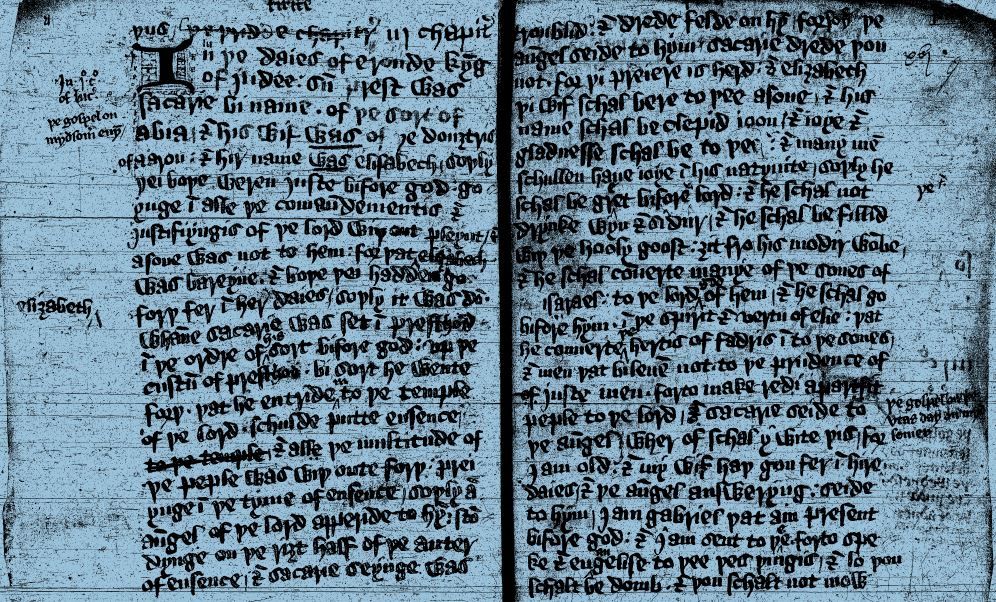
A Latin gospel harmony, Concordia Quattuor Evangelistarum or Unum ex Quattuor, is one of several works attributed to Clement of Llanthony, and was probably written in the middle of the twelfth century at Llanthony Secunda Priory in Gloucester (see llanthonysecunda.org). It was translated into Middle English in the late fourteenth century and appears to have been the work of scholars translating the Old and New Testaments in what is termed the Wycliffite Bible or the Middle English Bible.
This site prints Clement’s Latin and the Middle English Oon of Foure side by side, chapter by chapter, in the harmony’s twelve parts. The Latin is edited from MS Hatton 61, with variants in the notes. Clement chose carefully: the harmony does not contain every word of the Gospels, and some of its readings are not in the standard modern Vulgate, though most are variants found in Wordsworth and White’s Novum Testamentum.
Conventions
- Mt [5:3] Gospel references in the Latin. The Gospels are abbreviated Mt, Mr, Lv and Io, as in the manuscripts.
- Verse numbers follow Forshall and Madden’s edition of the Wycliffite Bible, which uses the Vulgate numbering, so that Oon of Foure can be compared with the Earlier and Later Versions. The one exception is Luke 10, where Forshall and Madden divide the Vulgate’s verse 41 and so number the chapter to verse 43.
- On the text pages the Wycliffite Bible button adds the Earlier Version, the Later Version or both, from Josiah Forshall and Frederic Madden, eds, The Holy Bible … made from the Latin Vulgate by John Wycliffe and his followers (Oxford, 1850), for the verses each chapter of Oon of Foure uses. The Variants box shows their manuscript variants, with the reading they replace marked ⸢ … ⸣. The Later Version text in that edition begins Luke at 1:5.
- The Differences box highlights the words of Oon of Foure that differ from the version or versions shown, and in the Earlier and Later Version columns the words that Oon of Foure renders differently. Words are compared after spelling is levelled (þ and th, ȝ, u and v, i and y, doubled letters, final -e, in to and into, and so on), so the highlighting marks differences of wording, not of spelling. A dotted underline shows that Oon of Foure agrees with a manuscript variant recorded by Forshall and Madden; hover over a word to see the reading and the manuscripts. The alignment is made by computer and is a guide, not a collation: it can go astray where the harmony rearranges words.
- 1:5 Verse markers in the Latin, given every few verses within a long passage.
- ⟨ … ⟩ Latin of Unum ex Quattuor not translated in Oon of Foure.
- [Mt [8:28] …] Text that Oon of Foure has but Unum ex Quattuor does not.
- [ ] Letters or words supplied by the editor.
- f.27r Folio numbers of the Middle English manuscript.
- 1 Notes on the Latin, with variants: open “Notes to the Latin” beneath each chapter.
Using the site
Read the text part by part, showing both columns or either one. The Gospel index shows where each verse of the Gospels appears in Oon of Foure, and the Calendar gives the lessons for the church year. Search looks through both texts, and treats þ as th and ʒ as gh or y.
How to cite
Each chapter has its own address and a citation beneath it. For example:
Paul Smith, ed., Oon of Foure / Unum ex Quattuor, IIII.I, https://ioiiii.org/part-4.html#IIII-I.